Real eBay profit is what the buyer paid (item plus shipping) minus what you paid for the item, eBay's fees, ad fees, the actual shipping label and packaging. eBay's dashboard shows sales, not profit, so costs like ad fees and shipping overages are easy to miss.
I made over $67,000 in the past 11 months selling on eBay. This is what my screen tells me:
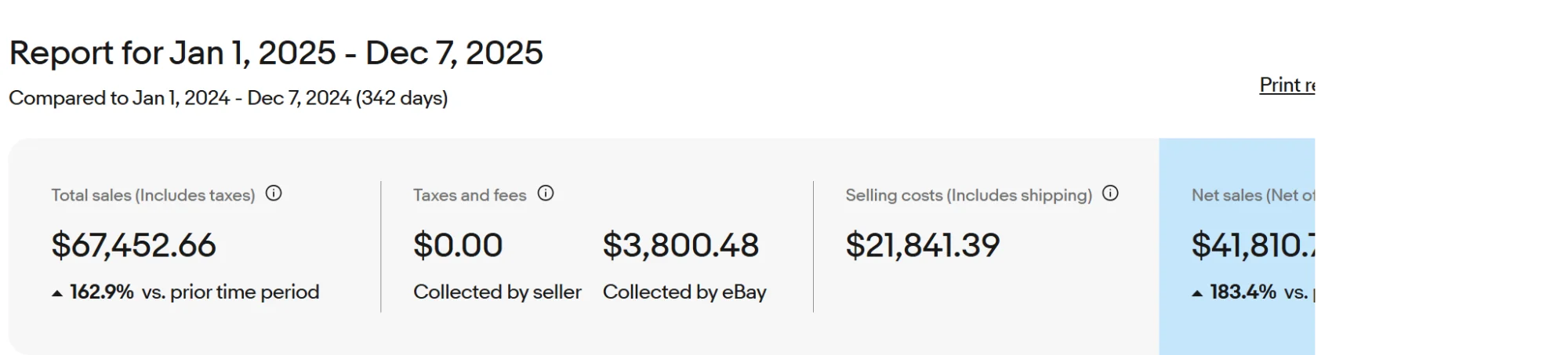
eBay Seller Hub - Looks great, right?
Sounds great, doesn't it? Sixty-seven thousand dollars for taking some pictures and shipping things. I'm doing great for my second year — up 162% from last year. Looks like I can hang up the day job and ride the easy wave.
Well... not so fast.
Here's what my numbers actually look like when I track everything:
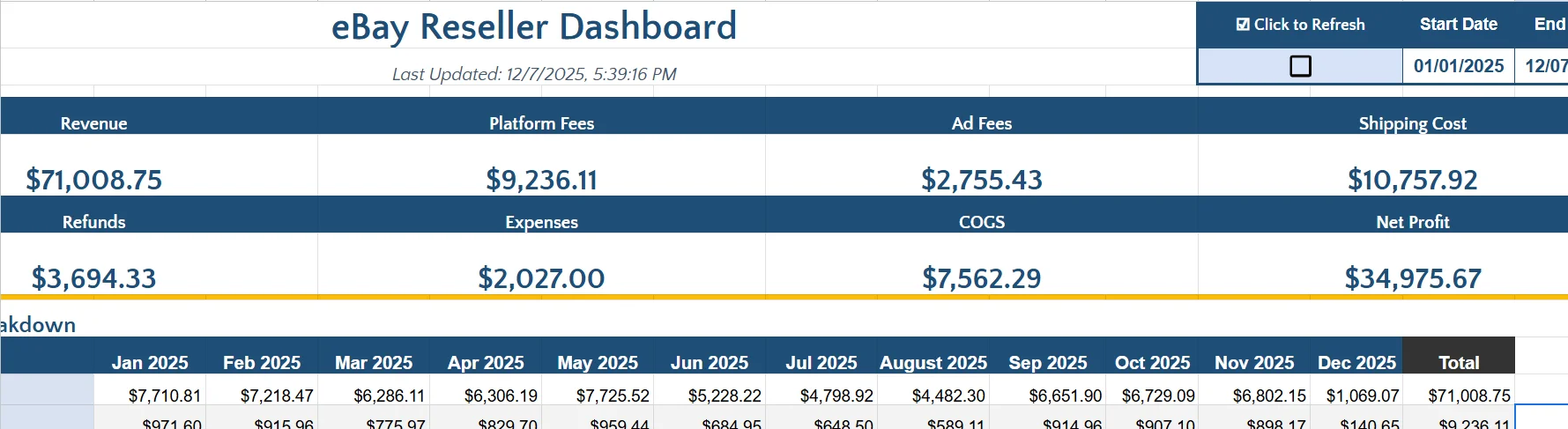
The real numbers after tracking every cost
That's a $32,000+ difference between gross revenue and what actually hit my pocket. And even eBay's "net sales" figure of $41,810 is about $7K higher than reality — because it doesn't account for COGS, business expenses, or the full picture.
Let's dig into why this happens.
Quick eBay Profit Calculation Checklist
- Track your COGS — Record what you paid for every item you resell.
- Calculate actual eBay fees — FVF (13.6% in most categories), the per-order fee ($0.40 on orders over $10), and promoted listings.
- Track shipping cost overages — What buyers paid vs. what you actually paid for labels.
- Include packaging and supplies — Boxes, tape, poly mailers add $0.50-$1.00+ per package.
- Allocate sourcing mileage — At $0.70/mile, even short trips add up.
- Apply the profit formula — Sale Price - COGS - Fees - Shipping - Packaging - Mileage = True Profit
Want to check a single sale? The free eBay profit calculator does the fee math for you, including the fee eBay charges on shipping and sales tax.
What eBay Tells You vs. Reality
Here's a question that keeps resellers up at night: How much money am I actually making?
If you're like most eBay sellers, you probably have a rough idea. You sold a pair of boots for $240, paid $6 for them at Goodwill, so you made $234. Right?
Not even close.
Log into eBay's Seller Hub and you'll see your "Total sales" number front and center. It's a nice dopamine hit. But that number is your gross revenue — what buyers paid you, not what you kept.
eBay's reports will show you final value fees and promoted listing costs if you dig around. But they won't show you:
- What you paid for the item (your COGS)
- The gas you burned driving to source it
- Shipping costs that exceeded what the buyer paid
- Returns where you lost the item AND the fees
- Packaging materials
- Your eBay store subscription, spread across items
This isn't eBay's fault — they can't know what you paid for inventory or how far you drove. But it means their "profit" metrics are meaningless for understanding your actual business.
The Hidden Costs Eating Your Margins
Let me show you a real example from my sales this year. I sold a pair of Lucchese cowboy boots for $242.95 — a solid sale. Here's what actually happened to that money:
1. Cost of Goods Sold (COGS)
I picked these up at a local thrift store for $6.48. Easy to remember for one item — impossible to remember for 500+ items a year.
Impact: -$6.48
2. eBay Final Value Fee
eBay takes 13.6% in most categories, on the total the buyer pays (item price, shipping and sales tax), plus a per-order fee. On this sale, eBay's fees came out to $35.55.
Impact: -$35.55
3. The Per-Order Fee
On top of the percentage, eBay adds $0.40 to every order over $10 ($0.30 at $10 or less). It's already inside the $35.55 above, but it's the part that's easy to forget when you do the math in your head. Small per order, but it adds up fast.
Impact: included in the $35.55
4. Shipping Cost Overage
The buyer paid $12.72 for shipping, but the actual label cost me $17.70. That $4.98 difference comes straight out of my profit. This happens more often than you'd think — I wrote a whole post about common eBay shipping mistakes that cost me $200 early on.
Impact: -$4.98
5. Packaging Materials
Box, tissue paper, tape. Call it $0.75 per package on average.
Impact: -$0.75
6. Sourcing Mileage
The round-trip drive to that thrift store, allocated across the items I bought that day. At the 2025 IRS rate of $0.70/mile, even a small trip adds up.
Impact: ~$1.00
| Line Item | Amount |
|---|---|
| Sale Price + Shipping | +$255.67 |
| COGS (what I paid) | -$6.48 |
| eBay fees (final value + per-order) | -$35.55 |
| Shipping Label (actual cost) | -$17.70 |
| Packaging | -$0.75 |
| Sourcing Mileage (allocated) | -$1.00 |
| TRUE NET PROFIT | $194.19 |
Quick mental math said ~$236 profit. Reality: $194.19. About $42 less than I would've guessed — and this was a great sale.
The Formula for True Profit
Here's the complete formula you should be using for every item:
The hard part isn't the math — it's tracking all the inputs. Most sellers don't fail at profit calculation because they can't subtract. They fail because they never recorded the COGS, or they forgot about ad fees, or they didn't track their mileage.
Why This Matters More Than You Think
You're Making Bad Sourcing Decisions
If you think you're making $50 on an item but you're actually making $30, you might pass on a $20 item that would net you $35. Or worse, you'll keep buying items that barely break even after all costs.
The Fee Rate Is Brutal
When I actually tracked it, my overall fee rate came out to 37.2%. That's over a third of every sale gone to fees before I even count what I paid for the item.
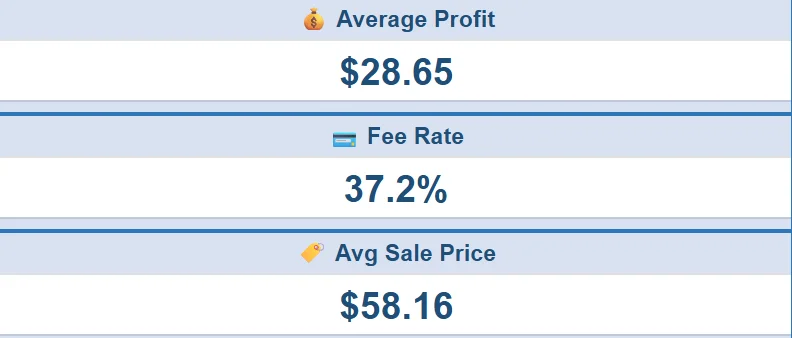
My average sale price is $58.16, but my average profit is only $28.65. Without tracking this, I'd have no idea where my money was actually going.
Returns Will Wreck You If You're Not Watching
Returns are profit killers that most tracking systems ignore. When a $50 item comes back, you don't just lose the sale — you lose the original shipping cost, potentially the return shipping, and eBay often keeps their fees anyway. One return can wipe out the profit from 3-4 other sales. I wrote a complete guide to handling eBay returns if you want to dig deeper into this.
My return rate this year is 6.1%. That means roughly 1 in 16 sales results in a return — and each one of those is a significant hit to the bottom line.

Tax Time Becomes a Nightmare
When you track true profit throughout the year, tax prep takes hours instead of days. Your COGS is documented. Your mileage is logged. Your Schedule C practically writes itself. For what the IRS says about taxes on eBay sales, and how to read your 1099-K, see do I have to pay taxes on eBay sales?
How to Actually Track This
You have a few options:
Option 1: Manual Spreadsheet
Build your own Google Sheet. Create columns for every cost category. Enter data manually after every purchase and sale.
This is exactly what I did for my first year. And I hated every minute of it.
I'd be out all day sourcing and shipping items, then come home and have to clean the items, take pictures, list them... and then sit down and manually copy-paste all my order data into a spreadsheet. One by one. Order ID, item name, fees, shipping cost — tedious as hell.
I had one little cell where I'd put the total cost I spent that day. That was the extent of my COGS tracking. One cell.
I was spending 20-30 minutes a day just on data entry.
If you'd rather stick with a spreadsheet, the free eBay spreadsheet template has the columns and profit formulas already set up, for Excel or Google Sheets.
Option 2: Accounting Software
QuickBooks, Wave, or similar tools can work, but they're built for traditional businesses. You'll spend more time configuring categories and fighting the interface than actually tracking profit. They also don't understand eBay's fee structure or connect to your sales data.
Option 3: Purpose-Built Tools
This is why I built Autotabit.
I was so frustrated with the manual process that I decided to build something better. It started as a Google Sheets add-on and is now a web app that connects to eBay, pulls your orders and fees automatically, and lets you log COGS and sourcing trips properly. The profit calculations happen automatically.
That 20-30 minutes a day I was spending on data entry? Now I spend less than 2 minutes logging my multi-stop sourcing trips. Everything else syncs automatically.
Once I saw how much time it saved me, I figured other resellers might want the same thing.
Start Today: The 15-Minute Audit
Here's a quick exercise to see where you actually stand:
- Pick your last 10 sales from Seller Hub
- Look up the actual fees for each (Payments → Download report)
- Estimate your COGS as best you can remember
- Check your shipping costs vs. what buyers paid
- Calculate true profit using the formula above
Compare that number to what you thought you made. If there's a significant gap, you now know why tracking matters.
The Bottom Line
Reselling is a real business, and real businesses know their numbers. eBay gives you revenue data. Everything else — COGS, true fees, shipping overages, returns, mileage — is on you to track.
I made $67,000 in gross sales this year. My actual profit was $35,000. That's still good money, but it's a very different picture than the dashboard showed me.
The sellers who treat this seriously are the ones who scale. They know which items are actually profitable. They know when to walk away from a sourcing trip. They know their true hourly rate.
The sellers who don't? They stay stuck wondering why their bank account doesn't match their eBay dashboard.
Which one do you want to be?
Frequently Asked Questions
How do I calculate eBay profit?
True eBay profit = (Sale Price + Shipping Collected) - COGS - eBay Fees (FVF + per-order fee) - Ad Fees - Actual Shipping Cost - Packaging - Allocated Mileage/Sourcing costs. Most sellers only subtract COGS from sale price and miss 30-40% of their actual costs.
What percentage does eBay take from sellers?
eBay takes a 13.6% Final Value Fee in most categories (on the total the buyer pays, including shipping and sales tax), plus a per-order fee: $0.30 on orders of $10 or less, $0.40 above that. With promoted listings, payment processing, and shipping overages, total fees typically run 35-40% of your sale price.
What is COGS for eBay resellers?
COGS (Cost of Goods Sold) is what you paid for the item you're reselling. For thrift store flippers, it's the price tag. For retail arbitrage, it's your purchase price. COGS is tax-deductible and essential for calculating true profit.
Why is my eBay profit lower than expected?
eBay's dashboard shows gross revenue, not profit. Hidden costs include: shipping overages (when actual cost exceeds what buyer paid), promoted listing fees, packaging materials, sourcing mileage, returns, and eBay store subscription fees spread across items.
What is a good profit margin for eBay reselling?
After all costs, experienced resellers typically see 40-60% net profit margins on individual items. However, this varies widely by category and sourcing method. The key is tracking every cost to know your actual margins rather than guessing.
Ready to Know Your Real Numbers?
Autotabit pulls your eBay data, tracks COGS, logs sourcing trips, and calculates true profit automatically.
Start FreeHave questions about tracking eBay profit? Reach out at support@autotabit.com — I read every email.